
HỘI THIỀN TÁNH KHÔNG TRUNG ƯƠNG

FR020 LES 5 ENTRAVES À LA MÉDITATION - Traduit en Français par Nhất Hòa – Relu par Hồng Thúy

Tuesday, January 16, 202410:39 AM(View: 3995)

LES 5 ENTRAVES À LA MÉDITATION
 blank

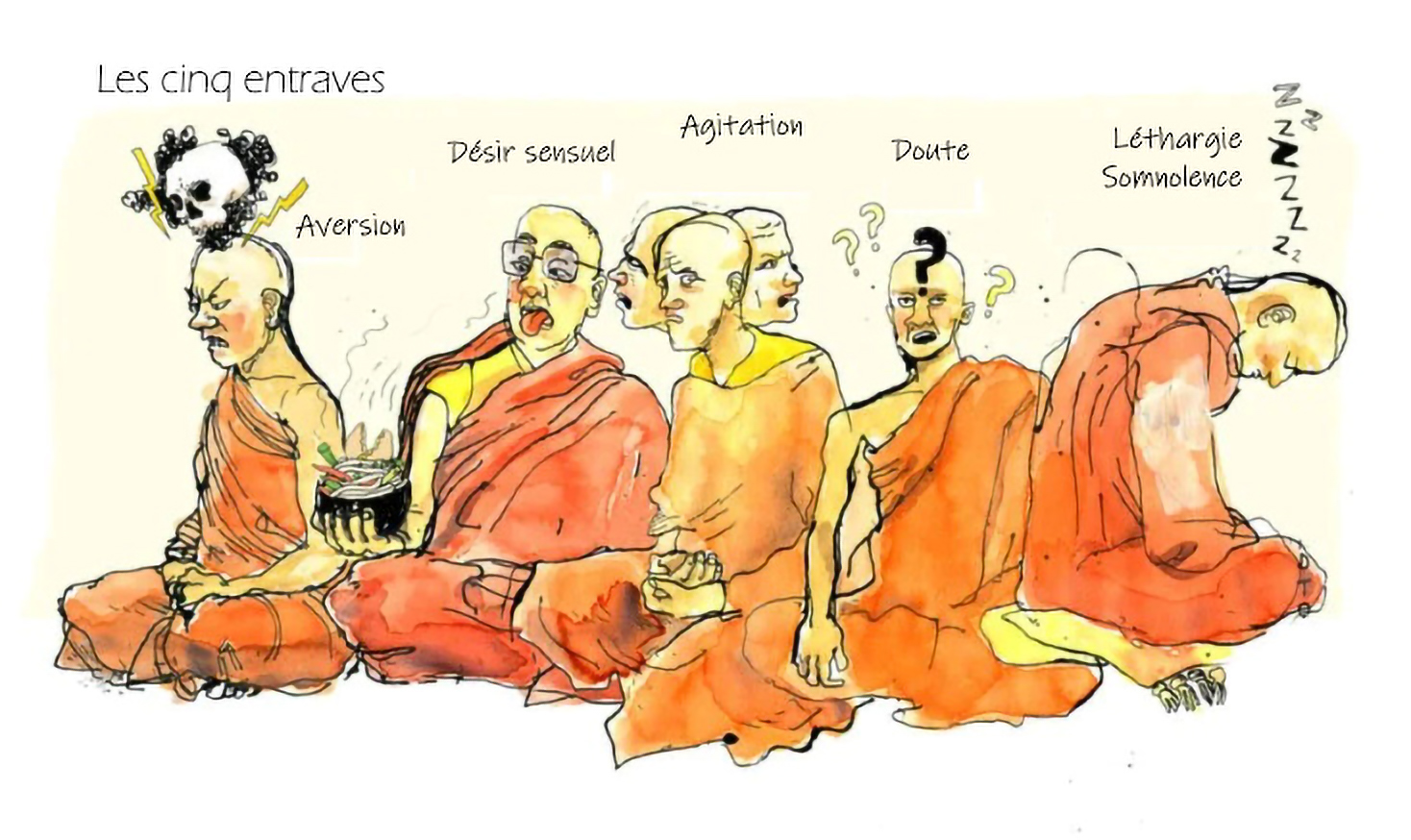
Les cinq entraves sont les cinq liens qui enchaînent l'esprit humain dans les afflictions, créant ainsi de nombreux karmas qui le conduisent vers le samsara. Ces obstacles obstruent notre clarté d'esprit de telle manière que nous sommes embrouillés par l'ignorance et incapables de s'éveiller. Pour les pratiquants du Zen, ces cinq obstacles sont des mauvais dharmas :

  1. Les désirs sensoriels
  2. L'aversion
  3. La léthargie et la somnolence
  4. L’agitation mentale et les remords
  5. Le doute

qui les empêchent d'atteindre un mental calme et immobile, essentiel pour le développement de la sagesse menant à l'Illumination et à la Libération.

Le Bouddha a dit : "Tant que les cinq obstacles ne sont pas éliminés, le moine les contemple au sein de lui-même comme une dette, comme une maladie, comme une prison, comme un esclavage ou comme une traversée du désert (1)." Nous devrons apprendre à les reconnaître et à les éviter afin de progresser sur le chemin de la méditation.

Tout d'abord, nous devons comprendre la signification de chaque obstacle et ensuite appliquer la méthode du Bouddha pour les surpasser.

1) Les désirs sensoriels

Quelle que soit la sensation que nous éprouvons, qu’il s’agit d’un petit souhait, un son doux, un goût délicieux ou une sensation enivrante, aussitôt qu’ils sont plaisants, le désir sensoriel est là, ne serait-ce qu’un bref instant.

En général, c'est le désir des plaisirs procurés par les 5 sens, qu’il s’agit de la vue, de l'ouïe, du toucher, du goût, de l’odorat ou de la pensée, ainsi que les désirs sans bornes de richesses, de beauté, de renommée. De plus, les désirs sensoriels englobent également le plaisir dans les activités sexuelles, de bien manger et de bien dormir, de ne pas endurer des moments douloureux et tristes, et à la fin de vouloir toujours vivre avec des sensations agréables en toutes circonstances. Ce sont les exigences de la nature humaine.

On dit souvent que plus on a de désirs, plus les afflictions augmentent. C'est vrai, mais malheureusement, bien qu'ils sachent cela, la plupart des gens continuent à lutter pour assouvir leurs désirs, puis se lamentent de leur malheur et de leur souffrance !

Un moine est une personne éclairée qui veut sortir d'une vie tourmentée par ses désirs. Lorsque les désirs sensoriels sont totalement absents, le bonheur sera présent. L’esprit goûtera alors au bien-être procuré par sa capacité à demeurer paisiblement sur son objet de méditation.

2) L'aversion

C'est l'esprit en colère contre des situations désagréables ou contrariantes. Une personne en colère est quelqu'un qui veut s'opposer, se quereller, combattre ou détruire. La colère est un état négatif qui est caché en chaque être humain, et qui émerge lorsque les conditions sont réunies. Conscient de la toxicité de la colère, le Bouddha a enseigné que l'avidité, la haine et l'illusion sont les trois poisons qui ont la capacité de détruire l'âme et le corps des gens, non seulement dans cette vie, mais aussi dans de nombreuses vies à venir. Dans les soutras, il est aussi dit que la colère est plus cruelle et dangereuse que le feu. Elle est comme un bandit, un serpent venimeux. Une seule pensée de colère brûle facilement toute la forêt du mérite. Il faut donc trouver tous les moyens pour l'en empêcher.

La colère a de nombreux états et de différents niveaux d'expression tels que : le dégoût, la tristesse, l’emportement, l'irritation, le rejet, le ressentiment, la haine. La colère se manifeste dans les expressions faciales, la parole et les pensées. Elle est exprimée par des attitudes telles que faire des grimaces, froncer les sourcils, rouler des yeux, grincer des dents. Ou en expression verbale telle que crier, hurler, injurier. Elle est aussi exprimée par des gestes et des actions telles que jeter des objets, battre, tourmenter, poignarder, tuer des gens... Parfois, la colère et la haine ne se manifestent pas extérieurement mais restent enfouies dans le coeur comme veulent dire les expressions populaires suivantes : "vivre avec sa haine et l'emporter dans la mort" ou "une vendetta au-delà de la mort". La colère conduit les gens aux mauvais karmas à travers des mots, des pensées et des actions. C'est la cause du Samara.

Pour les pratiquants du Zen, la colère est une aversion pour l'objet même de sa méditation, le détournant facilement au profit d'autres objectifs. Lorsque le mécontentement est totalement absent, la joie sera présente. L’esprit intéressera alors à son objet de méditation.

3) La léthargie et la somnolence

C'est la fatigue du Corps et la torpeur du Mental. C'est un état de lassitude du Corps et de léthargie du Mental. Le pratiquant débutant tombe souvent dans cet état lorsqu'il perd la Pleine conscience et que son esprit s'éloigne du sujet. Puis il glisse peu à peu dans un état semi-conscient, à moitié endormi, à moitié éveillé. C'est l'état où notre énergie et notre attention sont brouillées ou éteintes.

Méditer c'est entraîner son Mental. Lorsque la léthargie et la somnolence nous envahissent, nous n'avons plus d'énergie pour faire quoi que ce soit. La baisse d'énergie conduira à la somnolence. La léthargie fait perdre à la conscience sa clarté, glisse vers la fragmentation, s'affaiblit puis s'éteint. Ainsi la somnolence s’installe dans la méditation à notre insu.

4) L’agitation mentale et les remords

L'agitation a deux faces, l'agitation du Corps et l'agitation de l'Esprit. Le corps n'arrivait pas à rester tranquille, se balançant ou bougeant sans arrêt pour changer de position, les yeux jetant des coups d’oeil devant et en arrière. Ou lorsque la méditation est trop intense, provoquant fatigue ou douleur du corps, conduisant facilement à un état de découragement et de paresse dans la pratique. L'agitation de l'Esprit est l'état du Mental submergé par les pensées pendant la méditation. Dans les soutras, ce Mental est appelé un "mental errant" sautant d'une pensée à une autre comme un singe balançant de branche en branche, sans arrêt, ou un mental, insatisfait du sujet de la pratique, constamment à la recherche vers d'autres sujets plus attrayants. Trouver d'autres sujets signifie que le méditant est sous l'emprise du doute.

Le regret est aussi un état particulier d'agitation de l'Esprit. Ce Mental agité est causé par une conscience pleine de remords des erreurs passées. C'est le résultat karmique des mauvaises actions antérieures qui rend l'esprit instable pendant la méditation.

5) Le doute

Un Mental hésitant ne parvient pas à distinguer le bien du mal. Ce qui signifie que le méditant se pose beaucoup de questions sur sa propre capacité à pratiquer. Il commence à douter, non seulement de ses propres capacités, mais aussi de celles de son guide, de l'enseignement, de la méditation en général, du Bouddha ou du Dharma.

Le doute peut également être vu comme une autre forme d'état d'agitation. Lorsqu'il y a trop de connaissances et de concepts dans l'esprit, celui-ci devient hésitant et indécis. Par conséquent, les questions et les préoccupations pendant la méditation en position assise doivent être évacuées complètement avant la pratique.

Lorsqu'il décide de pratiquer le Zen, le méditant doit avoir une croyance ferme, comprendre le sujet et la technique de la pratique du Zen et saisir clairement son but.

Conclusion

La Voie du Zen est le chemin de retour vers notre vraie Nature. Sur le chemin, nous devons franchir de nombreuses portes. L'une de ces portes est celle des "cinq entraves". Après avoir passé ces "cinq obstacles", nous devons également abandonner les murmures et les dialogues mentaux afin de demeurer paisiblement dans le deuxième niveau de Jhana, c'est-à-dire le Samadhi sans murmures mentaux, le niveau le plus difficile à atteindre. Lorsque notre mental est entièrement calme, sans murmure mental, les "cinq obstacles" ne peuvent plus interférer dans notre voyage. Par conséquent, la voie de perfectionnement s'ouvrira clairement devant nous. Nous goûterons alors au bien-être procuré par le dhamma et ainsi, nous développerons nos capacités d'Éveil.

THÍCH NỮ HẰNG NHƯ
Août 17-2018

Source : Năm triền cái là gì ?
Traduit par Nhất Hòa, relu par Hồng Thúy


  1. MN39 - Le grand récit d’Assapura 

Auteur : Hằng Như
Publié le : 11-01-2024 - 12:35

 

Send comment
Off
Telex
VNI
Your Name
Your email address
Sunday, February 1, 20266:44 PM(View: 121)
Ni Sư Triệt Như đã có một buổi gặp mặt thân mật với Đạo Tràng Tánh Không Nam Cali vào ngày 17 tháng 1 năm 2026.
Tuesday, February 3, 20266:14 PM(View: 60)
Tóm lại điểm then chốt trong chánh kiến là: Trên phạm vi Chân đế, ta cần đạt được tri kiến thể nhập chân lý Trên phạm vi Chân đế, ta cần đạt được tri kiến thể nhập chân lý (saccapaṭivedhañāṇa - knowledge in penetration into the truths). Phần này gồm 2 điểm: 1) Biết như thật khổ, nguyên nhân khổ, sự diệt khổ, và con đường đưa đến diệt khổ./ 2) Biết như thật ta là chủ của nghiệp do ta tạo nên. Triệt tiêu được ý niệm "Ta," ý niệm về nghiệp chấm dứt. Không có nghiệp để trả và cũng không có người chịu quả báo
Tuesday, February 3, 20264:47 PM(View: 74)
So actually, Morality, Concentration, and Wisdom are just the three words, or just the tools. The Buddha laid them out to guide human beings of different capacities, just like the Eightfold Path, the Seven Factors of Awakening, Taking Refuge, or Leaving Household… All of them are merely speech or words temporarily shown by the Buddha. We shouldn’t closely attach to the language. Instead, we need realize what deeply hidden within the letters.
Tuesday, February 3, 20269:29 AM(View: 80)
Wenn ich heute zurückblicke, sind zwar erst wenige Jahre vergangen, doch es fühlt sich an, als wären es hundert gewesen. Die glücklichen Tage sind so schnell vergangen. Fünfundzwanzig Jahre. Wir konnten nicht einmal unsere Silberhochzeit feiern, dann ging einer nach dem anderen. Der Herbst kommt, dann der Frühling, dann wieder der Herbst … Jetzt hängen nur noch zwei gelbe Blätter am Zweig. Einsam und verlassen.
Monday, February 2, 20263:23 PM(View: 94)
Theo đạo Phật tất cả mọi sự vật, sự kiện, hiện tượng sinh ra do nhiều điều kiện. Vì do nhiều điều kiện, tức nhiều duyên kết hợp mà thành, gọi là “duyên sinh”, nên không thực chất tính, không độc lập, không tự ngã. Vì không tự ngã nên không tồn tại bất biến, luôn luôn ở trong trạng thái sinh diệt. Quá trình biến đổi liên tục trên vạn pháp trong thế giới vật chất, hay ngay cả trong tâm thức con người gọi là Vô thường.
Tuesday, January 27, 20265:26 PM(View: 218)
There it is! The dreamlike land! My place of peace is this Patriarchal Temple, and it is also the whole world. How could there truly be coming or going and life or death? Wherever we go, it is still within this mundane life. Whether alive or dead, all of it is merely circling within this dreamland.
Sunday, January 25, 20267:43 PM(View: 226)
Khổ chỉ cho đặc tính phổ biến của tất cả sự hiện hữu, nói chung đều bất toại nguyện (unsatisfactoriness) đưa đến những xung đột nội tâm.
Wednesday, January 21, 20266:17 PM(View: 273)
Thắp sáng nội tâm hay soi sáng nội tâm là khai mở ánh sáng trí tuệ soi rọi vào bên trong tâm để nhận ra bản chất thực sự của chính bản thân mình và vạn pháp bên ngoài. Ánh sáng trí tuệ này giúp chúng ta có một cuộc sống an lạc và thăng hoa hơn.
Tuesday, January 13, 20266:11 PM(View: 461)
Today, recalling stories from the old days which were only some years ago; yet it feels like endlessly distant. Joyful days passed so quickly! Twenty years gone! There wasn’t even the chance to celebrate the twenty-fifth anniversary before everyone had drifted away. Fall is coming, then spring, then autumn again. And now, only two yellow leaves remain, lonely and thinly clinging to the branch.
Wednesday, January 7, 20269:42 AM(View: 555)
Aber wann denke ich denn nicht an unseren Meister? Ein gelbes Blatt fällt runter. Auf dem letzten Gemälde ist lediglich eine purpurrote Salablüte zu sehen, die herabfällt. Oder ein einzelnes, gelbes, trockenes Blatt, das von einem Zweig gefallen ist und im Garten verstreut liegt.
Tuesday, January 6, 202612:19 PM(View: 524)
In conclusion, a sudden breakthrough or realization must occur at least once, or even multiple times, along the path of practice for one to truly enter the Chan house. Only then can one walk forward freely, no longer encountering obstacles within the mind. If one has not yet realized the original mind, one is still standing outside the gate... Once the latter is clearly realized, the former naturally fades away.
Sunday, December 28, 20259:56 PM(View: 516)
Sáu năm trôi qua, từ ngày vắng bóng Thầy, chúng đệ tử vẫn tiếp tục hành trì pháp Thầy truyền trao. Các thiền sinh vẫn siêng năng họp chúng tu tập hằng tuần trên online, mỗi hai tháng các vị ấy đều về Thiền Viện nhập thất, cùng nhau ôn tập và chia sẻ kinh nghiệm tu tập.
Thursday, December 25, 20254:05 PM(View: 927)
Mùa tưởng niệm Thầy, lúc nào lại không là mùa tưởng niệm Thầy? Một chiếc lá vàng rơi. Bức tranh cuối cùng này chỉ có một đóa hoa sala đỏ thắm rơi hay một chiếc lá vàng khô, lìa cành, rơi rụng trong vườn.
Tuesday, December 23, 20252:44 PM(View: 550)
Gọi là hương vị, vì người viết đã nếm được vị vô thường, nhận ra được tánh sinh diệt là điều tự nhiên, là sự vận hành của pháp... nên mỗi khi nhớ đến Thầy thì trong lòng không còn đau buồn hay sợ hãi trước những thay đổi bất ngờ xảy ra trong cuộc sống. Bạch Thầy, học trò kính dâng lên Thầy lòng thương kính và tri ân vô bờ.
Tuesday, December 16, 20258:47 AM(View: 645)
Tháng 12, TƯỞNG NIỆM ÂN SƯ cùng nhau nghe lại tiếng nói của Thầy Thực hiện VIDEO: NHƯ ANH Đạo tràng Toronto
Thursday, December 11, 20253:03 PM(View: 685)
Schools and lineages, Zen masters, various means of Dharma teachings are all conditioned phenomena. They arise and cease. The Utmost Truth, however, is unconditioned, eternal, and does not come and go.
Thursday, December 11, 202510:09 AM(View: 690)
Tháng 12, TƯỞNG NIỆM ÂN SƯ cùng nhau đọc lại bài viết về Thầy của Ni sư
Wednesday, December 3, 20253:01 PM(View: 629)
Muốn đạt được “Trí tuệ vô lậu”, hành giả phải tu học, hành trì ba môn Vô lậu Giới-Định-Tuệ, là pháp môn mà Đức Phật đã đi qua và thực chứng trí tuệ ba minh (Túc mạng minh, Thiên nhãn minh, Lậu tận minh) dưới cội Bồ đề.
Wednesday, November 26, 20253:38 PM(View: 720)
Chinese Chan Buddhism is regarded as having begun with its First Patriarch, Bodhidharma, an Indian monk, via the “lion’s roar” awakened people to return to their original mind and recognize their inherent nature—empty, quiescent, and luminous.
Wednesday, November 19, 20257:46 PM(View: 1062)
TÀI LIỆU HỌC TẬP: Khóa THIỀN CĂN BẢN 2025_KỲ 5 ngày 28 tháng 6, 2025 do Ni Sư Triệt Như trực tiếp hướng dẫn. Bao gồm các AUDIO & SLIDES từ Bài 17 đến Bài 20 có tại LINK: https://www.tanhkhong.org/p105a4826/ky-5
Saturday, November 15, 20257:59 AM(View: 691)
Kinh Trường Bộ Tập 1 8. Kinh Ca-diếp Sư tử hống (Kassapa-Sìhanàda sutta) còn có tên là Kinh "Đại sư tử hống" (Mahàsìhanàda Sutta)
Tuesday, November 11, 20258:39 PM(View: 767)
So hat Buddha gelehrt: „Seid euch selbst ein Licht, dem ihr folgen könnt. Nehmt zur Wahrheit Zuflucht . Verlasst euch auf niemanden und nichts anderes!. Denn alles ist vergänglich“.
Tuesday, November 11, 20258:27 PM(View: 864)
All the sects and sub-lineages in these two great transmission traditions have preserved the essential teachings of the Buddha and share the same ultimate goal: liberation from suffering, enlightenment, and self-emancipation.
Monday, November 10, 20258:10 PM(View: 1075)
TÀI LIỆU HỌC TẬP: Khóa THIỀN CĂN BẢN 2025_KỲ 5 ngày 28 tháng 6, 2025 do Ni Sư Triệt Như trực tiếp hướng dẫn. Bao gồm các AUDIO & SLIDES từ Bài 17 đến Bài 20 có tại LINK: https://www.tanhkhong.org/p105a4826/ky-5
Wednesday, November 5, 20252:07 PM(View: 782)
Ba cánh cửa giải thoát “ Không, Vô tướng, Vô tác ” là trí tuệ siêu vượt của Đức Thế Tôn trao truyền cho người hữu duyên. Đây là sự quán chiếu sâu sắc vê “ duyên khởi, tánh Không, vô thường, vô ngã và Niết-bàn ”.
Tuesday, November 4, 20259:29 AM(View: 707)
Kinh Tăng Chi Bộ Chương 8 Tám Pháp VIII. Phẩm Song Đôi (73) Niệm Chết (1) (52) Niệm Chết (2)
Tuesday, November 4, 20251:31 AM(View: 1139)
TÀI LIỆU HỌC TẬP: Khóa THIỀN CĂN BẢN 2025_KỲ 5 ngày 28 tháng 6, 2025 do Ni Sư Triệt Như trực tiếp hướng dẫn. Bao gồm các AUDIO & SLIDES từ Bài 17 đến Bài 20 có tại LINK: https://www.tanhkhong.org/p105a4826/ky-5
Wednesday, October 29, 202512:54 PM(View: 1295)
TÀI LIỆU HỌC TẬP: Khóa THIỀN CĂN BẢN 2025_KỲ 5 ngày 28 tháng 6, 2025 do Ni Sư Triệt Như trực tiếp hướng dẫn. Bao gồm các AUDIO & SLIDES từ Bài 17 đến Bài 20 có tại LINK: https://www.tanhkhong.org/p105a4826/ky-5
Monday, October 27, 20253:44 PM(View: 828)
Kinh Trường Bộ Tập 1 8. Kinh Ca-diếp Sư tử hống (Kassapa-Sìhanàda sutta) còn có tên là Kinh "Đại sư tử hống" (Mahàsìhanàda Sutta)
Wednesday, October 22, 20259:28 AM(View: 870)
The Buddha taught the last wholehearted words before leaving this world: “Be a lamp unto yourself.” “Rely only upon the Dharma.” “Do not depend upon anyone or anything else.” “ Because ‘Everything in this world is impermanent’. ”
Tuesday, October 21, 202511:29 PM(View: 1106)
Ni Sư Triệt Như Khóa THIỀN CĂN BẢN 2025 Bài 16: TÁNH THẤY - Ngày 21 tháng 6, 2025 tại Thiền Đường Tánh Không Nam Cali. Bài viết bao gồm VIDEO và các SLIDES.
Monday, October 20, 20258:54 PM(View: 897)
Wir nennen sie die Motten „selbstverbrennende Insekten“, weil sie direkt ins Licht fliegen und tot zu Boden fallen, sobald sie die heiße Glühbirne berühren. Ich frage mich, welcher Instinkt sie dazu treibt und warum sie vom Licht angezogen werden. Warum fliegen sie immer wieder in die Glühbirne, obwohl sie sehen, wie andere Motten dabei ums Leben sterben?
Monday, October 20, 20254:06 PM(View: 1211)
Chapter 14, titled "Detachment from Forms to attain Tranquility," stands as one of the most vital and profound chapters within the Diamond Sutra. Its full name conveys that by letting go of all phenomenal forms and delusive thoughts, one can attain the state of ultimate stillness and cessation (Nirvana).
Wednesday, October 15, 20252:16 PM(View: 1523)
Ni Sư Triệt Như Khóa THIỀN CĂN BẢN 2025 Bài 15: TÁNH NGHE Ngày 21 tháng 6, 2025 tại Thiền Đường Tánh Không Nam Cali.
Tuesday, October 14, 20256:47 PM(View: 1073)
Wherever coming, why did Venerable Bhaddiya keep saying, “Oh, peaceful indeed”? The other monks looked around, seeing only a quiet forest, a tree bottom, or an empty hut, and could not understand. They assumed Bhaddiya was recalling his luxurious royal life. This shows the worldly habit of common people projecting on their own subjective thinking.
Monday, October 13, 20257:52 PM(View: 1322)
Both "The Mu Koan" (in Japanese Zen Buddhism, especially the Rinzai school) and the "No-Talk" Technique (belonging to the Sunyata Meditation of Venerable Thich Thong Triet, a modern Vietnamese tradition rooted in Abhidharma and Nikāya) aim for a common goal: the direct realization of the Awareness Nature beyond words and concepts. However, their methods and psycho-cognitive contexts fundamentally differ.
Monday, October 13, 202511:12 AM(View: 6523)
Kinh Tăng Chi Bộ Chương 8: Tám Pháp VI. Phẩm Gotamì (51) Mahàpajàpatì Gotamì (52) Ai Giáo Giới?
Saturday, October 11, 20255:15 PM(View: 790)
Quán pháp trên các pháp trong kinh Tứ Niệm Xứ được hiểu là nhìn sự vật bằng cái nhìn khách quan, nhìn cái đang là của đối tượng ngay trong hiện tại, dù đối tượng thiện hay bất thiện trong tâm không phản ứng đồng ý hay bài xích.
Friday, October 10, 20254:10 PM(View: 783)
Kinh Phật Tự Thuyết Chương 1 Phẩm Bồ Đề (Udàna)
Wednesday, October 8, 202512:20 PM(View: 1373)
Ni Sư Triệt Như Khóa THIỀN CĂN BẢN 2025 Bài 14: TƯ THẾ TỌA THIỀN Ngày 21 tháng 6, 2025 tại Thiền Đường Tánh Không Nam Cali.
Wednesday, October 8, 202511:31 AM(View: 1418)
Dans la pratique du Méditation, la méthode de relaxation de l’esprit ou de relaxation des pensées constitue une partie essentielle dans la création d’une réponse biologique immédiate permettant de guérir les maladies psychosomatiques et la neurasthénie. Elle est l’antidote à la dépression (stress), aux troubles émotionnels et elle rétablit les dysfonctionnements du système nerveux.
Wednesday, October 8, 202511:25 AM(View: 866)
A person’s life is also like a constantly flowing stream, never stopping. Everything, health, youth, happiness, loved ones, all flows forward in a one-way direction: birth-aging-sickness-death, or in another way: arising-existing-decaying-disappearing. This one-way path means that once something has passed, it never returns exactly as it was.
Monday, October 6, 20253:14 PM(View: 986)
Kinh Trường Bộ Tập 1 Phần 2 2. Kinh Sa-Môn Quả (Sàmannaphala sutta) (The Fruits of the Contemplative Life)
Wednesday, October 1, 202510:41 AM(View: 1137)
Au final, le chemin du perfectionnement réside uniquement dans un ksana. Un ksana de pleine conscience. Un ksana pour savoir comment vivre. C’est celui de l’étant. Rester dans le ksana de l’étant en permanence. C’est demeurer paisiblement dans le Nirvana.
Wednesday, October 1, 20259:34 AM(View: 1393)
Because of inner speech, the Mind never truly rests, even during sleep. Inner speech is the very fuel of liking (craving), disliking (aversion), and of various addictive passions, traditions, and attachments to family, society, and so on. It is the root of Suffering (delusion), for it is precisely what gives rise to psychosomatic illnesses, causes conflicts with others, and creates imbalance with the living environment.
Wednesday, October 1, 20259:30 AM(View: 1347)
Dans le parcours de pratique et de réalisation, le Bouddha n’a pas enseigné à chercher une divinité suprême ou une entité éternelle à l’extérieur, mais Il a directement montré à l’intérieur de ce corps-esprit, afin que le pratiquant puisse reconnaître la nature véritable de lui-même. L’un des enseignements essentiels qui aide le pratiquant à revenir à sa nature pure est la reconnaissance des quatre facultés : Voir, Entendre, Toucher et Percevoir.
Wednesday, October 1, 20259:26 AM(View: 1124)
For a long time now, the pepper tree has reminded me of the art of living, " adapting to situations yet staying unagitated." Its trunk is sturdy and solid, standing tall against the vast sky. Despite wind and rain, the trunk does not shake. This tree surely has a hard inner core. In the Buddhist discourse “The Simile of the Heartwood”, the Buddha compared the ultimate goal of virtuous life to mind liberation, which is similar to the heartwood of a tree, its most valuable part. The heartwood lies hidden deep inside the trunk, hard to see and find. Mind liberation is also abstract, difficult to seek and attain.
Monday, September 29, 20257:04 PM(View: 1852)
Ni Sư Triệt Như Khóa THIỀN CĂN BẢN 2025 Bài 13: NHỮNG TƯ THẾ THỰC TẬP THIỀN - Ngày 21 tháng 6, 2025 tại Thiền Đường Tánh Không Nam Cali. Bài viết bao gồm VIDEO và các SLIDES có tại LINK: https://www.tanhkhong.org/p105a4815/tai-lieu-hoc-tap-cac-slides-khoa-thien-can-ban-2025-ky-4-ngay-21-thang-6-2025.
Sunday, September 28, 202512:24 PM(View: 963)
Trung Bộ Kinh Tập 1 Phần 39 1. Đại kinh Xóm ngựa (Mahà-Assapura sutta)
Wednesday, September 24, 202510:07 PM(View: 1092)
Trung Bộ Kinh Tập 1 Phần 1 1. Kinh Pháp Môn Căn Bản (Mùlapariyàya sutta) (The Root Sequence)
Wednesday, September 24, 202510:38 AM(View: 1251)
This presentation compares the 'No-Talk' technique, from the Sunyata Meditation lineage taught by Venerable Thich Thong Triet, with Chapter 9: The Dharma-Gate of Non-Duality in the Vimalakirti Sutra, to clarify the similarities in their practice content and the state of mind that both methods aim to achieve.
Wednesday, September 24, 202510:31 AM(View: 1134)
Since the time we’ve been in this world, through countless lives, it remains faithful, side-by-side to us to remind of good and wholesome things. Many times, we might betray it or neglect it. But it keeps loyal to us. Who’s it? It’s the Knowing, the Mind. Thus, my friends, remember to live every moment fully with this silent, true-blue and crystal-clear ride-or-die companion.
Saturday, September 20, 20253:49 PM(View: 1036)
Tam giới gồm ba cõi : Cõi Dục, cõi Sắc, cõi Vô Sắc là toàn bộ vũ trụ quan theo cái nhìn của Phật giáo. Tùy mức độ nghiệp lực và khả năng tu tập, mà chúng sanh sẽ tái sinh, sống ở một trong ba cõi này.
Thursday, September 18, 202510:37 AM(View: 1028)
There are two different types of spiritual backgrounds for renunciation. 1- For lay people. They get ordained due to: Decline of Old Age, Decline of Illness, Decline of Possessions, Decline of Beloveds and Blooded Relations 2- For those who are sagacious. They get ordained due to: The world is impermanent and subject to destruction, The world is aidless and unprotected, The world is non-ownership. When leaving it, one must drop down everything behind, The world is needy, insatiable, and enslaved by cravings...
Sunday, September 14, 20254:35 PM(View: 1547)
Ni Sư Triệt Như Khóa THIỀN CĂN BẢN 2025 Bài 12: THIỀN QUÁN ANUPASSANÀ - Ngày 14 tháng 6, 2025 tại Thiền Đường Tánh Không Nam Cali. Bài viết bao gồm VIDEO và các SLIDES.
Sunday, September 14, 20254:35 PM(View: 1655)
Ni Sư Triệt Như Khóa THIỀN CĂN BẢN 2025 Bài 11: NÃO BỘ - Ngày 14 tháng 6, 2025 tại Thiền Đường Tánh Không Nam Cali. Bài viết bao gồm VIDEO và các SLIDES.
Tuesday, September 9, 20254:59 PM(View: 1013)
“I abandon my own mind and live in the best alignment with those venerables’ one.” And Utmost Lord, we are of different bodies, but our mind is unified.”
Friday, September 5, 202512:35 PM(View: 1669)
Các ông đều trình bày đúng theo kinh nghiệm của mỗi vị. Còn đây là câu trả lời của ta: “Tỷ-kheo sau khi đi khất thực và thọ trai về, ngồi kiết-già, lưng thẳng, đặt niệm trước mặt, và nghĩ rằng: "Ta sẽ không bỏ ngồi kiết-già này cho đến khi tâm của ta được khéo giải thoát khỏi các lậu hoặc, không có chấp thủ.'' Này Sāriputta, hạng Tỷ-kheo như vậy có thể làm sáng chói khu rừng Gosinga.
Wednesday, September 3, 20251:00 PM(View: 1220)
Tóm lại, theo lời Đức Phật, con cái phải luôn tâm niệm báo đền công ơn cha mẹ. Sự hiếu thảo của con cái đối với cha mẹ không chỉ dừng lại ở sự phụng dưỡng về vật chất, mà còn phải khuyến hóa cha mẹ hướng đến đời sống thiện lành, phát khởi tín tâm với Phật pháp, thực hành giữ giới, bố thí...
Wednesday, September 3, 202511:57 AM(View: 1617)
Ni Sư Triệt Như Khóa THIỀN CĂN BẢN 2025 Bài 9: Bài Kinh NHẤT DẠ HIỀN GIẢ - Ngày 14 tháng 6, 2025 tại Thiền Đường Tánh Không Nam Cali. Bài viết bao gồm VIDEO và các SLIDES.
Wednesday, September 3, 202511:30 AM(View: 1206)
At first glance, the title might sound kinda broad, sublime and even so fancy. Yeah, it is! How could we fully refer to such a thoughtful topic just in a few pages? Even it might take one book to write about a way of life. So, I’m gonna stay in the Buddhist viewpoint to talk about the Boddhisatva’s lifestyle under the term “Four Dharma for Mind Subduing”.
Tuesday, September 2, 20258:18 PM(View: 1603)
Sau khi nhận ra rõ ràng sự hiện hữu của thiên nhiên và con người trên thế gian, do nhân và duyên mà có mặt, lại do nhân và duyên mà thay đổi và biến mất rồi lại tái sinh, dòng sống của con người và thiên nhiên cứ tuôn chảy mãi như thế không ngừng, người ẩn sĩ cô độc trong khu rừng già bên bờ sông Nerañjarā (có khi viết là Niranjana) giờ đây đã thấy rõ tất cả những diễn tiến trong đời, đã tháo gở ra tất cả các sự rối ren phiền muộn từng ấp ủ ray rứt trong tâm.
Tuesday, September 2, 20253:32 PM(View: 1116)
Le terme Dhamma, depuis l’Antiquité jusqu’à aujourd’hui, possède de très nombreuses significations et un sens très vaste. C’est pourquoi je vais provisoirement les regrouper afin de les répartir en trois contenus différents, c’est-à-dire qu’on peut les classer en trois sens distincts du mot Dhamma.
Saturday, August 30, 20257:46 PM(View: 1488)
Saturday, August 30, 202511:36 AM(View: 1374)
Cette année, l’Association Sunyata Suisse (ASS) a organisé la retraite à Tulette et non plus au Camp de Vaumarcus. Tulette est un petit village situé au sud de la France. Mme Huệ Thuận, responsable de l’ASS possède un vignoble et une oliveraie à Tulette. Le terrain est vaste avec beaucoup d’espaces libres couverts d’herbe. Le bâtiment principal compte un étage et en tout neuf chambres à coucher.
Thursday, August 28, 20257:10 PM(View: 1437)
Ni Sư Triệt Như Khóa THIỀN CĂN BẢN 2025 Bài 8: HAI SẮC THÁI TÂM - Ngày 7 tháng 6, 2025 tại Thiền Đường Tánh Không Nam Cali. Bài viết bao gồm VIDEO và các SLIDES.
Thursday, August 28, 20256:57 PM(View: 1114)
Thất giác chi không chỉ là bảy yếu tố quan trọng hỗ trợ hành giả trong vấn đề tu tập thiền hướng đến giác ngộ giải thoát, mà Thất giác chi còn có giá trị thực tiễn trong đời sống hằng ngày của người cư sĩ chúng ta.
Wednesday, August 27, 202512:49 PM(View: 1331)
The joking words of the Master’s long-term students are the conclusion for this piece. In daily life, “No bargaining.” Why? When someone quotes a price, it’s what they’re expecting. When we say yes to it, they’ll be so happy, right? We, mind practitioners, should bring joy to everyone. So, yeah! “No bargaining.” Dear friends, a Master can thoroughly understand his disciples. But the disciples could hardly grasp their Master’s full depth of compassion.
69,256